

530A / Trump Accounts
National Disability Institute is working to ensure that children with disabilities and their families are aware of and can access the benefits of the new 530A / Trump Accounts, and if eligible, eventually roll those funds into ABLE accounts. While these early-life investment accounts present a meaningful opportunity to build long-term financial security, awareness and access will be critical to ensuring the disability community benefits from these resources.
A Unique Opportunity for Your Child’s Future
For families of children with disabilities, a 530A (Trump Account) can be an important first step toward long-term financial security. Each year, approximately 3.6 million children are born in the United States. While about 3% are identified with significant disabilities at birth, that number grows to more than 8.5% by school age. Eligible children born between January 1, 2025, and December 31, 2028, will receive a $1,000 federal contribution to a 530A account, with additional contributions permitted beginning July 4, 2026, from family members, friends, and employers.
More than 1.2 million of these children are expected to become eligible for an ABLE account, creating a unique opportunity to extend the benefits of a 530A account into a lifetime disability savings strategy. Together, these accounts can help families build long-term financial security, benefit from compound growth, and protect eligibility for SSI and Medicaid while saving for future qualified disability expenses.
Start Early. Grow Savings. Get $1,000!

ABLE Accounts Matter
ABLE accounts are designed specifically for people with disabilities and allow individuals and families to save for disability-related expenses while maintaining eligibility for important public benefits.
If your child may one day qualify for an ABLE account, a Trump Account can help you begin saving now while keeping future investment options open.
ABLE Accounts Expand 530A/Trump Accounts:
- Roll eligible 530A / Trump Account funds into an ABLE account at age 17.
- Continue saving for qualified disability-related expenses.
- Help protect Supplemental Security Income and Medicaid eligibility.
- Builds long-term financial independence.
ABLE accounts provide:
- A powerful, tax-advantaged way to save and invest.
- Greater financial independence.
- The ability to save for housing, education, assistive technology, and other qualified disability expenses.
- The opportunity to build savings without jeopardizing eligibility for essential public benefits.
About 530A/Trump Accounts
530A Accounts at a Glance
- For a child under 18 with a valid Social Security number.
- One 530A account per child.
- Friends and family can contribute up to $5,000 per year.
- Employers may contribute up to $2,500 of the annual limit.
- Funds are invested to help savings grow over time.
- 530A accounts officially open July 4th, 2026.
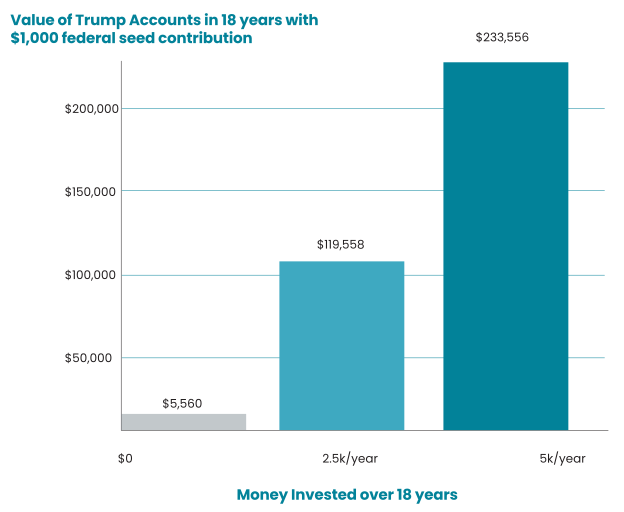
What Could $1,000 Grow Into?
The $1,000 federal seed contribution is designed to grow over time through investment!
Children Receiving Supplemental Security Income (SSI)
- The money in a 530A / Trump Account, including the $1,000 federal seed contribution and other contributions, do not count as income, or resources for SSI through the end of the year your child turns 17.
- In the year your child turns 17, funds are eligible to roll over into an ABLE account.
- Money cannot be withdrawn from the account during the growth period.
Resources
Watch our 90-second video to see how 530A and ABLE accounts can support your child’s future

Help Spread the Word!
 Share our video resource or share our PDF with families, schools, advocates, and community organizations. Greater awareness can help more children with disabilities and their families take advantage of early savings opportunities and build a stronger financial future.
We’ve developed three easy-to-share resources—a flyer, a presentation deck, and an FAQ . Download below!
How to Start Saving in a 530A Today
In Five Easy Steps
Step 1: Confirm the child is eligible, under the age of 18 and has a Social Security number, and gather basic information.
Step 2: Complete Form 4547 by signing in to your IRS account with ID.me.
Step 3: Download the app “Trump Accounts: Official App” and create your child’s account. If you have any questions, you can also call the center at (866) 872-4547.
Step 4: Accounts officially open on July 4, and funding begins. Families, friends, and employers may then contribute, and eligible children will begin receiving their $1,000 federal seed contribution.
Step 5: Keep your records in a secure place, watch for updates as your child gets older, and think about whether an ABLE account could help in the future.
Use this checklist to see if you’re ready to open a Trump Account for your child.
☐ My child is under age 18.
☐ My child has a valid Social Security number (SSN).
☐ I have completed (or am ready to complete) Form 4547.
☐ I know contributions may begin July 4, 2026.
☐ I have learned about ABLE accounts and how they may help my child save for disability-related expenses.
General Questions on 530A/Trump accounts
What is a 530A/Trump Account?
A 530A/Trump Account is a federally backed, tax-deferred savings account designed to give American children a head start on long-term financial security. It functions like a custodial traditional Individual Retirement Account (IRA). The account is held in the child’s name, but a parent or legal guardian manages it as the custodian until the child reaches adulthood.
Who is eligible to have a 530A/Trump Account?
Any child who is a U.S. citizen under the age of 18 with a valid Social Security number is eligible for a 530A/Trump Account.
What is the $1,000 federal government contribution?
Children born between January 1, 2025, and December 31, 2028, qualify for a one-time $1,000 “pilot program” seed contribution from the U.S. Department of the Treasury. This money is deposited automatically once the account is established and does not count towards the annual contribution limit of $5,000.
How much money can be contributed each year?
Individual Contributions: Parents, grandparents, relatives, or friends can contribute a combined total of up to $5,000 per year (indexed for inflation after 2027).
Employer Contributions: Employers may contribute up to $2,500 per year to an employee’s child’s 530A/Trump Account. Employer contributions count toward the overall annual contribution limit.
Charities/Government: Certain governmental entities and charities may also make qualified general contributions to 530A/Trump Accounts.
How are the funds in a 530A/Trump Account invested?
Funds t must be invested in a qualified, low-cost investment designed to provide long-term growth. Under current law, investments are limited to certain mutual funds or exchange-traded funds (ETFs) that track the S&P 500 or another broad stock market index made up primarily of U.S. companies. These investments are diversified across many companies, helping to reduce risk while allowing savings to grow over time. To help protect a child’s savings, the law also limits investment fees to 0.10% (10 basis points), ensuring that high fees do not significantly reduce account growth.
What happens to the 530A/Trump Account when the child turns 18?
The growth period ends on December 31 of the calendar year in which the child turns age 17. Beginning January 1 of the year the child turns 18, the account transitions out of the growth period and generally operates under the rules that apply to traditional IRAs.
The account remains owned by the beneficiary, who typically assumes control of the account at age 18 (or later in states with a higher age of majority). Earnings continue to grow tax-deferred, and withdrawals are subject to applicable tax rules and requirements.
Additional guidance may be issued regarding certain account features and public benefit considerations after the growth period ends.
Public Benefits & Supplemental Security Income (SSI) Protection Questions
Does owning a 530A/Trump Account affect a child’s eligibility for SSI?
According to current Social Security Administration (SSA) guidance, the full value of a 530A/Trump Account is excluded as a resource for Supplemental Security Income (SSI) purposes during the account’s growth period. The growth period lasts from the time the account is established through December 31 of the calendar year in which the child turns age 17.
SSA also states that contributions to a 530A including the $1,000 federal seed contribution, are not counted as income for SSI purposes. During the calendar year the beneficiary turns age 17; funds may be eligible to roll over to an ABLE account.
SSA has not yet issued complete guidance regarding SSI treatment after the growth period ends.
Do contributions and the $1,000 federal seed contribution count as income for SSI?
The recent SSA guidance provides two vital clarifications regarding income calculations:
Direct Contributions: Funds deposited directly into a 530A/Trump Account by family, friends, or outside sources do not count as income to the child for SSI purposes.
Federal Pilot Seed Money: The federal government’s $1,000 pilot contribution is explicitly excluded and does not count as income for SSI eligibility.
What happens to a 530A/Trump Account when a child receiving SSI turns 18?
For families receiving SSI, this transition is especially important. Current SSA guidance excludes the value of a 530A/Trump Account as a resource through the end of the calendar year in which the child turns 17. SSA may issue additional guidance regarding how the account will be treated for SSI purposes after that time.
Families will want to explore rolling eligible funds into an ABLE account during the year the child turns 17. This will help preserve resources for disability-related expenses while maintaining eligibility for important benefits. Under current law, a qualified rollover from a 530A/Trump Account to an ABLE account does not count toward the annual ABLE contribution limit of $20,000. Visit ABLE NRC for more information about ABLE Accounts.
Why should a family consider rolling over to an ABLE account at age 17, and how is it done?
For some families, rolling funds from a 530A into an ABLE account during the year the child turns 17 may provide important advantages. ABLE accounts allow eligible individuals with disabilities to save and use money for qualified disability expenses, such as housing, education, transportation, healthcare, assistive technology, and other disability-related needs.
In addition, ABLE accounts offer special protections for many means-tested benefits, including SSI and Medicaid, making them an important long-term savings tool for many people with disabilities.
If a rollover is permitted, the transfer must generally be completed as a direct rollover from the 530A/Trump Account to the ABLE account. Current federal guidance requires the entire balance of the 530A/Trump Account to be transferred; partial rollovers are not permitted.
Note for Families: When communicating with your local Social Security field office, you can reference the Social Security guidance to ensure staff properly document and develop your child’s 530A/Trump Account as an excluded resource. To register for a 530A/Trump account, file IRS Form 4547, download the app, and create an account!
Disclaimer: *Growth projections are based on average return of the S&P 500, past performance does not guarantee future results.
*Growth projections are based on average return of the S&P 500, past performance does not guarantee future results.