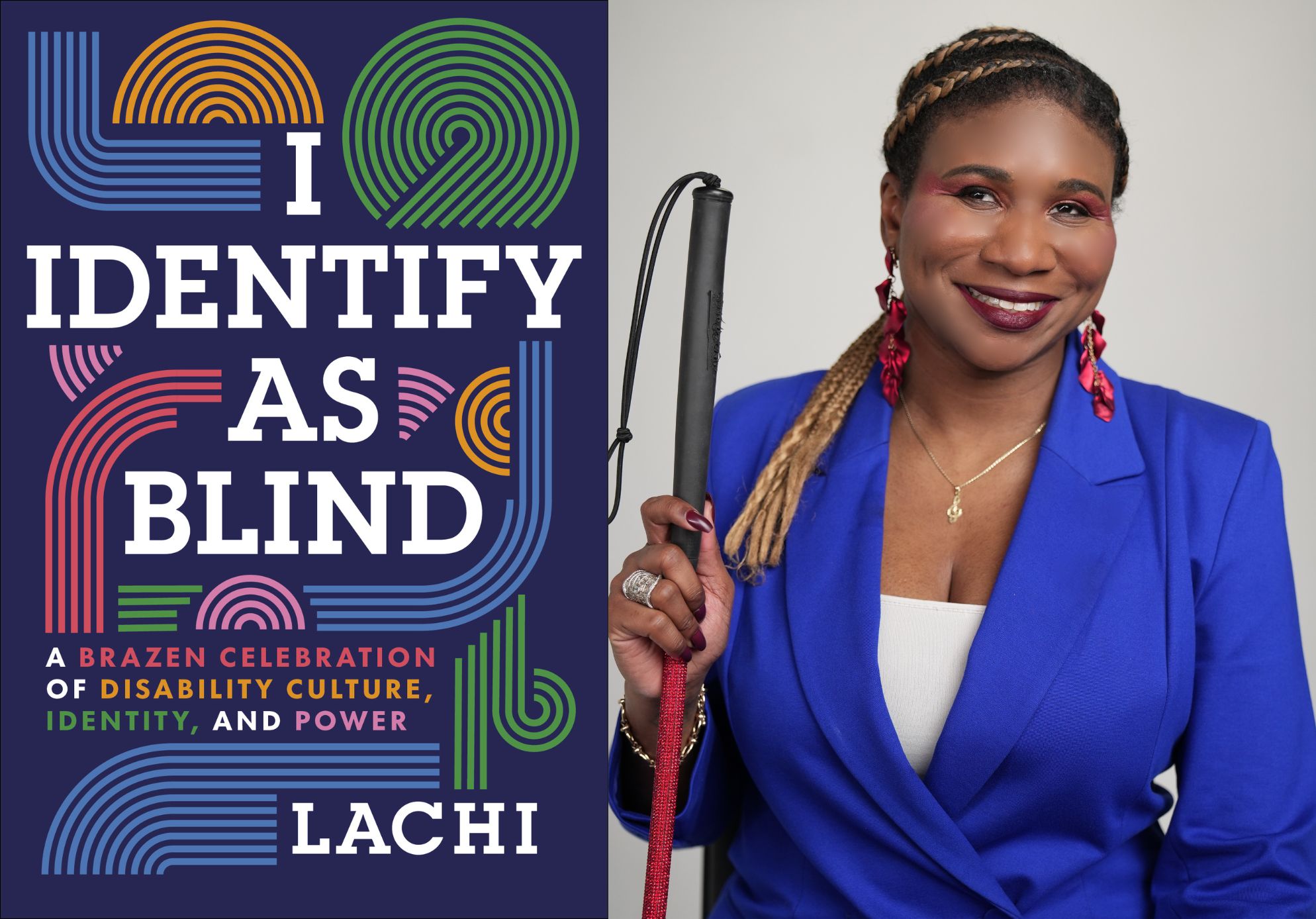
An edited excerpt from I Identify As Blind: A Brazen Celebration of Disability Culture, Identity, and Power.
Big Dis Energy: is a term award-winning musician and Glam Canes and RAMPD CEO Lachi coined to describe the innate ability to problem-solve, adapt, innovate and think creatively, thanks to the built-in drive and sense of self-determination that comes from a life of navigating the world differently.
As a blind woman, I’ve always had to figure out crafty ways to keep pace with my sighted counterparts. This led me to become fairly skilled at a lot of things: web design, audio engineering, copywriting, video editing and wisecracking. I really just have an ability to figure shit out. When I got to the point in my career where I needed a full creative team, I assembled a group of people like me, who specialize in autonomous problem solving and also have the drive and ability to figure [things] out. A team with strong Disability identity—or what I call “Big DIS Energy,” the innate ability to problem-solve, innovate and think creatively, thanks to the built-in drive and sense of self-determination that comes from a life of navigating the world differently…
…A BBC Bitesize article posits that the four characteristics of any competitive entrepreneur are creativity, risk-taking, determination and confidence. Kelsey Miller’s 2020 Harvard Business School article on entrepreneurship adds adaptability and focus to that list—and we all know how I feel about a high adversity quotient. These traits combine to create the type of visionary personality capable of founding and leading a successful venture. But to me, being adaptable, determined, creative and focused are innate to anyone who leans into their disability identity. That’s that Big Dis Energy.
Entrepreneurship is one of the most lucrative, accessible options for work age hustlers with disabilities. It turns out, many celebrated C-suite executives, tech entrepreneurs and visionary innovators are disabled or neurodivergent. Apple founder Steve Jobs navigated his way through life with dyslexia, as did Henry Ford and Ingvar Kamprad, the late founder of IKEA. Paul Orfalea, founder of Kinko’s, has ADD, as does Justin Timberlake, while David Neeleman, founder of JetBlue, famously celebrates the benefits of his ADHD. Then there’s my good friend Louis Posen, CEO of Hopeless Records, one of the most successful independent record labels in rock history. He is blind.
There’s a growing cadre of disabled and neurodivergent entrepreneurs and leaders across the identity spectrum kicking ass, taking names and bringing receipts. Dona Sarkar, chief engineer at Microsoft (women in STEM, let’s gooo!) and Emma Grede, cofounder and CEO of clothing brand Good American, are open about their dyslexia. Gena Harper— cross-country skier, rock climber and former senior VP at Morgan Stanley—attributes her success to the focus and drive her blindness has given her. Google’s global head of disability innovation, KR Liu, recognizes her hearing loss as an advantage, a sentiment that also rings true for Caroline Casey, the founder and executive behind the Valuable 500, who takes pride in her vision loss. Proudly disabled and queer, Andrew Gurza is the founder and CEO at Bump’n, a popular sex toy brand by and for disabled people. Sangita Desai was born with missing digits, and after 2006 floods destroyed her busy Mumbai fashion design studio, she pivoted toward her innate entrepreneurial talents and cofounded Raw Nature, India’s largest all natural cosmetics brand.
Now let’s go Black. Grammy Award–winning empire builder Will.I.Am, reality TV and music icon Ray J and Dr. Raven the Science Maven have all attributed aspects of their success to their ADHD. Ruby Taylor—founder and CEO of Financial Joy School, a platform successfully building generational wealth for Black and Brown families—credits her stuttering and brain injury for shaping her trajectory. Harvard MBA Jessica O. Matthews, a multi-patented inventor with lupus, is founder and CEO of sustainable infrastructure company Uncharted.
This list wouldn’t be complete without Daymond John, the force behind FUBU (For Us, By Us), the international brand and groundbreaking hip-hop fashion movement. A series regular judge on Shark Tank, John has spoken openly about his dyslexia and how it drove him to think beyond the ordinary. More recently, he developed hearing loss, and in a spirit of fashion-forward Disability Pride, said of his hearing aids, “I wear red hearing aids because I want people to ask me about them. Normally, hearing aids are flesh tone and blend in. My custom red ones stick out, and that’s why I love them.” Dude, I 100 percent relate.
Dang, Lachi, that is a fire list. Exactly! It proves unequivocally that a disability does not preclude someone from being a kickass innovator or wealth creator. In fact, an openly acknowledged well accommodated Disability identity can actually enhance people’s entrepreneurial badassery. That’s that Big Dis Energy. Let’s talk about it.
So as a blind neurodivergent woman, the CEO of both Glam Canes and RAMPD—a company that today works with giants like the GRAMMYs, Netflix and Live Nation to make the music industry more accessible and accommodating—and a National Trustee at the Recording Academy and committee member at the Television Academy among other entertainment industry board positions, I’ve always had to be crafty, driven and hyper focused just to keep up. I was undeterred by the “nos.” I worked to turn them into “not yets” while wielding a sharp Big Dis Energy sword—and a fierce Big Dis Energy team.
Author Note
Big Dis Energy is a Cultural Model lens (as opposed to Charity Model and Medical Model) through which I view disability. Because of this lack of media portrayals of amazing humans open about their Disability identity doing amazing things, I’ve become the representation I desperately needed, designing the adaptive fashion I wish I’d had growing up, founding and running the music org I wished I could have googled in high-school, telling the jokes I needed to hear, releasing the songs I needed to sing and writing the book I needed to read uplifting the role models I’d wish I’d known. Working with folks like NDI’s small business hub to enhance the skills we already know to be the designers of the things we need are vital to ensuring we retain ownership of our massive wealth of creativity. When we drop the mask and lean into the drive, innovation and power that accepting, embracing and eventually celebrating our Disability identity allows, that is when we are truly liberated.
 If you’re a small business owner (or want to be) with a disability, check out the NDI Small Business Hub at disabilitysmallbusiness.org. They’ve got the tools to help you get started—from business plans to finding funding.