
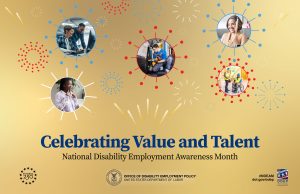
 Every October, we pause to honor something that should be obvious all year long: people with disabilities are part of the American workforce, and they always have been.
This is National Disability Employment Awareness Month, or NDEAM. The 2026 theme, set by the U.S. Department of Labor’s Office of Disability Employment Policy, is “Celebrating Value and Talent.” It’s the same theme as last year, carried forward as the country marks its 250th birthday.
We love that choice. It doesn’t ask anyone to prove their worth. It starts from the truth that the value and talent are already here.
A month with a long history
NDEAM began in 1945 as a single week. Congress expanded it to a full month in 1988, and today it’s observed by employers, schools, community groups and advocates across the country.
Eighty years in, the work is far from done.
The gap is still real
In 2025, just 22.8% of people with a disability were employed, according to the Bureau of Labor Statistics. About 3 in 4 people with a disability were outside the labor force, compared with about 1 in 3 people without a disability. And the unemployment rate for people with disabilities was double the rate for everyone else.
Those numbers aren’t a measure of talent. They’re a measure of barriers: inaccessible hiring practices, outdated assumptions, and a benefits system that can make working feel like a risk instead of a step forward.
Value means economic security, too
At National Disability Institute, we believe a job is more than a job. It’s a paycheck, a sense of purpose, and a path to building savings and a stable future. That’s why our work connects employment and financial well-being.
Work without fear of losing benefits. Many people who receive Social Security disability benefits want to work but worry about what happens to their income and health coverage if they do. Through the American Dream Employment Network (ADEN), NDI’s Employment Network under Social Security’s Ticket to Work program, people ages 18 through 64 who receive SSDI or SSI can get free help with job searches, career planning and work incentives. The program is voluntary, and it’s designed to help people increase their earnings with support along the way.
Save what you earn. ABLE accounts let people with disabilities save and invest without jeopardizing eligibility for programs like SSI and Medicaid. As of Jan. 1, 2026, anyone whose disability began before age 46 can open an account, up from age 26. That change makes about 6 million more people eligible. The 2026 annual contribution limit is $20,000, and account owners who work may be able to save even more through ABLE to Work. The ABLE National Resource Center can help you get started.
How you can celebrate this month
- Employers: Look at your hiring process with fresh eyes. Is your application accessible? Do your job postings describe the work, or a narrow idea of who can do it? Share the official NDEAM poster and invite employees with disabilities to shape how you mark the month.
- Job seekers: If you receive disability benefits and you’re curious about working, reach out to ADEN. You don’t have to have it all figured out to start the conversation.
- Families and allies: Learn about ABLE accounts and share what you learn. The expanded eligibility is new, and many people who now qualify don’t know it yet.
- Everyone: Join the conversation online with #NDEAM and lift up the stories of disabled workers in your community.
Talent is already here
“Celebrating Value and Talent” is a reminder, but it’s also an invitation. When people with disabilities can work, earn and save on their own terms, our workplaces, communities and economy are stronger for it.
This October, and every month after, we’re celebrating that talent. We hope you’ll join us.
Stay Connected with NDI
Don’t miss important resources, program updates and upcoming events. Subscribe to the NDI Newsletter.